
.png)


 |
| Image from MovieWeb |
Readers' Favorite

Showing posts with label Ross M Kitson. Show all posts
Showing posts with label Ross M Kitson. Show all posts
April 25, 2018
Arc of Triumph
by Ross M. Kitson
This week marks the release of Avengers 3: Infinity War, which I’m sure everyone with a social media account/ television/ eyes/ ears/ child is aware of. For those with only a passing interest in pumped-up actors fighting through a CGI saturated environment, you’d be forgiven for rolling your eyes and wondering what all the fuss is about. Yet beyond the likely movie profits that’ll rival the GDP of a small third world nation, I think the Avengers 3 marks a key moment in movie history—the culmination of a movie plot.

February 28, 2018
The Darkside
by Ross Kitson
I've just released the second book in my YA sci-fi series, excuse the shameless plug, and one sci-fi trope that the book features is the darker version of the hero. I'd written it into the story before I'd even really thought about the classic nature of it, and it wasn't until I got talking to a mate at work that I recognised how commonly it's become used in literature/ media of late.
I've just released the second book in my YA sci-fi series, excuse the shameless plug, and one sci-fi trope that the book features is the darker version of the hero. I'd written it into the story before I'd even really thought about the classic nature of it, and it wasn't until I got talking to a mate at work that I recognised how commonly it's become used in literature/ media of late.
December 27, 2017
He's Behind You!
by Ross Kitson

So this Christmas I've managed to wangle some time off between the big days and new year (which I have the joy of working) and for the first time since… well, since I was a child, I've got the pleasure of going to a pantomime. In my wife's family it's become a bit of a traditional trip to take the grandkids to the local pantomime, and in fact, Mrs. K tells a great story about being taken to the pantomime as a little girl by her own grandfather who was the mayor of Halifax at the time.
This year the show is Aladdin, which is a tried and tested pantomime play with not a hint of festivity about it, which for those that read the blog outwith anywhere in the former British Empire will probably leave them rather bemused and confused. So, with the benefit of my magical wand, and adopting the transient role of Fairy Godperson (gender neutrality mystically achieved) I shall enhance your knowledge of the pantomime tradition in the UK…
Purists would have the true origin of pantomime in the ancient classical era of Greek and Roman theatre, but the composition of said plays was far removed from the gaudy, bawdy, loud spectacle that I recall that I think I'll travel onwards through time to the 17th Century when an Italian travelling theatre began to utilise traditional tales and stories told with a set of regular supporting characters: these included characters who would become near-household names such as Harlequin, Clown, Scaramouche, and Pantaloon. These would form the basis of characterisations such as the comical, witty, cunning servant who latterly becomes the romantic lead (Harlequin), or the greedy old man/ father (Pantaloon). This 'commedia del' arte' developed with the harlequin character as a lover who eloped with the daughter of the greedy old father, usually involving a chase scene, and usually involving magical scene changes with Harlequin using his 'slapstick' to enact such sorcery.
In the UK in late Georgian/ Early Victorian times this 'harlequinade' started to utilise traditional fairy tales, folk tales, and nursery rhyme characters, often in synergy and often with adaptation of the plots. The presence of Harlequin as the key character began to alter with the evolution of Clown, and the seminal performances of Joseph Grimaldi whose depiction of the smiling trickster has fuelled many horror films and phobias ever since. Other recognisable pantomime characters then began to feature in the mid-to-late Victorian era, with Harlequin's transforming magic being taken by the Fairy Godmother, and the cross-dressing Pantomime Dame becoming a staple feature after the starring performances of Dan Leno.
Pantomime takes much of those traditional fairy tale elements and mixes them with garish outfits, slapstick, risqué comedy (designed to appeal to parents, not children), a certain Victorian burlesque, and the classical roles that have evolved from those nascent days of Harlequinades. To me, the essence of pantomime has to be…
The Dame: a bloke cross-dressing, often as the hero's mother (such as Widow Twanky), with plenty of smutty puns. Even Ian McKellan has taken his turn!
The lead boy character: is conversely played by a girl, often in an outfit that leaves no doubt. I can remember seeing Peter Pan as a child and getting really disturbed. It also makes me think of Blackadder's 'Bob' (from Blackadder 2: Bells) when I consider this.
Audience participation: think of a kid's version of the Rocky Horror Show, with everyone yelling "He's behind you!" or "Oh yes he is…" then "Oh no he isn't" and you get the idea. This is the best part for me, especially with the 'boos' at the villain, and the two halves of the theatre competing in sheer volume. Interestingly this audience participation is something that stadium rock seems to emulate, whether singing parts of the song, copying the singer, or sides of stadium competing!
Really really bad jokes (and double-entendres): still a very British thing, especially with the content of UK 'Carry on' films, or sitcoms. It permeates into US humour too, I think, but not to the same immature magnificence as here in Blighty.
And finally… why is it at Christmas? Quite simply, back in th' old days, the opportunity for the children to get to the theatres to see pantomimes was within 'holiday' seasons, and this was seized upon by David Garrick in the 19th century when he sought to promote the fun and frivolity of pantomime as an alternate to serious popular theatre in London's Drury Lane.
A tenuous link perhaps, but one that's very much part of the x-mas experience over here, and one that'll make me feel like a kid again but this time with my own children in tow. Of course, the other Xmas experience is likely to be the Star Wars movie, but I'll probably leave that one to another post.
Happy Xmas!
Get even more book news in your inbox, sign up today!. Girl Who Reads is an Amazon advertising affiliate; a small commission is earned when purchases are made at Amazon using any Amazon links on this site. Thank you for supporting Girl Who Reads.

This year the show is Aladdin, which is a tried and tested pantomime play with not a hint of festivity about it, which for those that read the blog outwith anywhere in the former British Empire will probably leave them rather bemused and confused. So, with the benefit of my magical wand, and adopting the transient role of Fairy Godperson (gender neutrality mystically achieved) I shall enhance your knowledge of the pantomime tradition in the UK…
 |
| Image from www.victoriatheatre.co.uk |
 |
| Maurice Sand [Public domain], via Wikimedia Commons |
In the UK in late Georgian/ Early Victorian times this 'harlequinade' started to utilise traditional fairy tales, folk tales, and nursery rhyme characters, often in synergy and often with adaptation of the plots. The presence of Harlequin as the key character began to alter with the evolution of Clown, and the seminal performances of Joseph Grimaldi whose depiction of the smiling trickster has fuelled many horror films and phobias ever since. Other recognisable pantomime characters then began to feature in the mid-to-late Victorian era, with Harlequin's transforming magic being taken by the Fairy Godmother, and the cross-dressing Pantomime Dame becoming a staple feature after the starring performances of Dan Leno.
 |
| Image from localbuzzmagazine.com |
The Dame: a bloke cross-dressing, often as the hero's mother (such as Widow Twanky), with plenty of smutty puns. Even Ian McKellan has taken his turn!
The lead boy character: is conversely played by a girl, often in an outfit that leaves no doubt. I can remember seeing Peter Pan as a child and getting really disturbed. It also makes me think of Blackadder's 'Bob' (from Blackadder 2: Bells) when I consider this.
Audience participation: think of a kid's version of the Rocky Horror Show, with everyone yelling "He's behind you!" or "Oh yes he is…" then "Oh no he isn't" and you get the idea. This is the best part for me, especially with the 'boos' at the villain, and the two halves of the theatre competing in sheer volume. Interestingly this audience participation is something that stadium rock seems to emulate, whether singing parts of the song, copying the singer, or sides of stadium competing!
Really really bad jokes (and double-entendres): still a very British thing, especially with the content of UK 'Carry on' films, or sitcoms. It permeates into US humour too, I think, but not to the same immature magnificence as here in Blighty.
 |
| Image from http://www.its-behind-you.com/gallery073.html |
A tenuous link perhaps, but one that's very much part of the x-mas experience over here, and one that'll make me feel like a kid again but this time with my own children in tow. Of course, the other Xmas experience is likely to be the Star Wars movie, but I'll probably leave that one to another post.
Happy Xmas!
Ross M. Kitson is a doctor, occasional blogger, full-time geek, and sporadic author of fantasy and YA sci-fi. Connect with Ross on Twitter.
Get even more book news in your inbox, sign up today!. Girl Who Reads is an Amazon advertising affiliate; a small commission is earned when purchases are made at Amazon using any Amazon links on this site. Thank you for supporting Girl Who Reads.
October 25, 2017
Candy Coloured Clown
by Ross M. Kitson

Given the less than subtle appearance of pumpkins and cobwebs everywhere I go it seemed an appropriate time to post about my re-kindled love affair with perhaps the greatest fantasy-horror series in modern comics: Neil Gaiman's 'Sandman.'
Amazon affiliate links are used on this site.
Back in 1988 one of my old friends gave me the heads up on a limited series by DC comics called Black Orchid, beautifully painted by Dave McKean and written by then newbie Neil Gaiman. The comic tied into the revitalised Swamp Thing series that Alan Moore had been writing, and I loved the in-depth literary style to the work. Gaiman had written only a few things by then (one in Imagine, a DnD magazine from the UK) but presumably impressed DC/ Vertigo enough to be handed over the title, Sandman, to do with as he wished. What he then did was take a tired superhero character and… well, totally mess with the genre.
 |
| Image from https://nerdist.com/ |
It was a great era for comics in the late 80s: Alan Moore, Grant Morrison, Jamie Delano, with the maturing of storylines and topics evident in both the mainstream titles, but also in the new imprints such as Vertigo. To me it is Gaiman's Sandman that stood the test of time, and my comic loving friend convinced me to part with my hard earned cash (I worked in 1989 as a silver service waiter whilst studying A-levels at the time) to buy the first issues of the comic, which I still have tucked away.
Nearly thirty years on, and having dipped into and out of them erratically over the years, I've decided to re-start reading the entire series. Handily now it's collected as a ten book series, and the first two give some idea about the style of the epic series. In the first book, Preludes and Nocturnes, we encounter the protagonist, Morpheus. Chalk-white skin with hair like Robert Smith from the Cure, we discover Morpheus is one of the Endless—a group of deities representing some aspect of being. Morpheus is also named Dream and has siblings such as Death (the coolest character in comics ever), Delerium, and Desire ('D' was a favoured letter in the Endless house, I assume). When we first meet him he is trapped by an arcane ritual and his totems stolen, and the first book involves him seeking them back. This involves encounters with other DC heroes of the time, but after this the series really diverges away from the mainstream DC Universe, explaining away the superhero Sandman (a Jack Kirby creation from the 70s) as a creation of escaped creatures from the Dreaming (his realm).
 |
| Image from https://www.goodreads.com/ (original from Sandman 1: Preludes and Nocturnes) |
What Gaiman created with the Sandman went on to be truly epic. Often the story arcs would involve Morpheus fairly peripherally, and not always as a benign character. It becomes clear as we read through that Morpheus has been an arrogant and often callous individual in the past, and many story threads relate to his redemption of past wrongs. Throughout this Gaiman creates a tangible mythology—of escaped nightmares, a novel interpretation of Hell and Lucifer, a dreamscape over which he rules, and the saga of the Endless as well as other traditional mythologies (such as Norse and Egyptian). His work balanced stand-alone short stories with multi-part tales (one being 13 parts), and at the time it really pushed the medium into the quality of mainstream literature. For me, the true skill was how Neil Gaiman brought in aspects of so many genres and wove them into a fresh perspective on mythology and fantasy. The mature aspects of the series, with serial killer crime, and disinhibited murderers, were never so horrific as to distract from the great prose and, importantly, the evolving characterisation. It's no mean feat to achieve this in the comic medium, and it puts the comic up there with some of the modern greats like Maus, Persepolis, Watchmen, V for Vendetta, and The Invisibles.
The Sandman ran to 75 issues, until 1996, and I strayed from the path in the 90s and never finished it. So swearing an oath to the Pumpkin King, I vow to complete the odyssey of Gaiman's first major work and see it through. Of course, Gaiman went on to branch from the comics genre and into many other areas. His books draw upon the themes and style he explored in the Sandman. You can see this, especially in the American Gods book, with the juxtaposition of old gods (from Norse, Egyptian, and Slavic mythology) and new (such as Media), and Anansi Boys, which also featured Mr. Nancy from the former novel. His love of fairy tales given a darker twist is evident in Stardust, and in Coraline—perhaps the scariest children's book I'd read in a long time (and for once a superb film adaptation of a book).
 |
| Image from film of Coraline via www.slate.com |
I remain glad that Sandman has not yet stepped into the celluloid/ televisual world. That's not me being precious about it, but most who've read the comics agree that it would be hard to capture the nuance and idiosyncrasy of the comics on TV. When I see shows such as Supernatural, Once Upon a Time or Grimm I can't help but see Gaiman's influence in them, and ironically Eric Kripke, creator of Supernatural, was once tipped for adapting the Sandman series. To me, it could only work as a series, preferably by HBO, CW or even Netflix. Time will tell, and I'd be surprised if it remains un-filmed.
So wish me luck on my epic journey, and if the post has made you curious why not join me and start reading the collection. Even if you're no comics fan perhaps you'll appreciate the wide-reaching plotlines and the evolution of the talent of Neil Gaiman.
'Never trust the storyteller. Only trust the story.' : Neil Gaiman: Sandman 6—Fables and Reflections.
 |
| Cover of Sandman issue 1 (1989) from http://www.davemckean-collector.co.uk/page_864008.html |
Ross Kitson is a doctor, occasional blogger, full-time geek, and sporadic author of fantasy and YA sci-fi. Connect with Ross on Twitter.
August 23, 2017
Time will Tell – Thoughts on the New Who
by Ross Kitson
For those who visit my alternate-month blog here on Girl Who Reads it can come as no surprise that today’s topic is one of the bigger news events for the sci-fi fandom of the last year. No, it’s nothing about Star Wars part… eight is it next? Or another re-vamp of the Star Trek universe not quite being as faithful as the last re-vamp. No… this is not only universe-shaking, it is actually reverberating through the entire time-vortex as I write.
The new Dr Who is a woman.
For casual viewers may be mildly surprised that the previously male Doctor, having being played by at least fifteen different actors of the XY persuasion, ranging in ages from 26 to 55, and one incarnation having being played by three actors (four if you include the films), is becoming female in the next regeneration. They might be even more surprised to discover an Armageddon scale reaction comparable to a Dalek-run Time-war amongst normally passive sci-fi fans.

In the most recent two seasons of Peter Capaldi’s incarnation we’ve had plenty of little teasers that it was possibly on the cards: the Doctor’s arch-nemesis, the Master, returned as a female—Missy; a Time-Lord (genderless terminology as it turns out) became a ‘Time-lady’ on regeneration after the Doctor rather uncharacteristically zapped him with a blaster. Although superficially human in appearance the Time-Lord race are quite biologically dissimilar—with two hearts, the ability to regenerate from mortal injuries, robust physiology (tolerant of extreme cold, space vaccum for short periods), low body temperatures, some telepathy etc etc. So, really, given that it is science-fiction, what is the big deal for fans?
(At this stage it’s probably relevant to mention that as a lifelong fan that I’m really excited by this, and by the choice of actress… anyhow, read on, read on).
With a show that has run (on and off) for over 50 years with a male lead the idea of the Doctor being a male, and an iconic one in sci-fi to rival Captain Kirk, Buck Rogers, Flash Gordon, and Darth Vader, was pretty cast-iron. No hint in that unrivalled narrative was made of the gender change potential of regeneration, with other Time-Lords displaying same-gender regeneration throughout (the Master and Romana being the main examples, up until two years ago). So the plot development of Missy being a female regeneration of the Master, whilst fun and wonderfully acted, felt rather shoe-horned and contrived. After all, even a fifty year sci-fi needs some ground rules, otherwise your plot solution will always err towards deus-ex-machina, like Superman comics in the Sixties. What has then seemingly irked fans is the concept this has been done for some covert political-correctness agenda. I’m uncertain where this idea has come from, as I’m not certain Dr Who had veered towards political correctness more than any other show—although the recent inclusion of homosexual and bisexual characters, and those of non-white companions, in a show where the most radical companion choice was Scottish/ Australian/ American played by British actors could be construed as such.
And such vitriol! My goodness, I was embarrassed to be a Dr Who fan (a Whovian as we’ve somehow been labelled) when I read some of the incredibly sexist statements posted on forums. The meme below satirises it perfectly. My personal ‘favourite’ was the ‘surely should be Nurse Who’ because, like obviously, doctors are men and nurses are girls (moronically ignoring that greater than 50% of entrants to medical school in the UK are female). But seemingly rational fans of a series whose underlying themes are ones of rebellion, non-conformity, tolerance of alien cultures, peace, and friendship, took to the anonymity of social media to post statements best placed in a TARDIS and sent back to the 1930s!
And all of this without even having seen Jodie Whittaker playing the Time-Lord. As a choice of actress she is excellent: she is relatively young (35, so the fourth youngest to play the Doctor); has a diverse career already in film, TV, radio, and stage; has landed a few Independent film nominations; and is from Yorkshire (near where I live!!!). And her own accent will irk the doomsayers even more, as it’s very Northern—lol.
Ironically, in sci-fi and fantasy, the increasing prominence of female leads is no new phenomenon. Games of Thrones is dominated by strong female characters (Daenerys, Cersei, Arya, Sansa) who actually survive. Star Trek took the plunge with Captain Janeway (Kate Mulgrew) in Voyager, and will continue the female lead in the new Discovery, with Lt Commander Michael Burnham (Sonequa Martin-Green). The latest Star Wars trilogy has Rey (Daisy Ridley) as the lead, and of course, Carrie Fisher was no shrinking violet in the original films (although perhaps not always garbed in costumes ideally suited for battling the Dark side). In Wonder Woman we finally have a contemporary female-led superhero film of good quality (note, I really liked Scarlett Johansen as Black Widow, especially in Captain America 2, but she wasn’t the lead).
Perhaps the most controversial decision in sci-fi casting before Jodie Whittaker as Dr Who was the re-imagining of Starbuck in Battlestar Galactica as a woman. And not just a shallow pretty depiction either, as Katee Sackhoff’s Kara ‘Starbuck’ Thrace was a hard drinking, gambling, promiscuous, thrill-junkie. Creating astonishing degrees of resentment when first revealed I think that, by the end of the new series four season run, she was a firm favourite even with the oldest die-hard fans (like me!). In a curious parallel with the casting of Whittaker the show runner, Ronald Moore, stated ‘We just decided that we didn't care.’ And I hope that’ll be the attitude of Chris Chibnall when he begins his run with Whittaker next year on Dr Who.
It’s a bold move, toying with something that’s essentially a modern cultural icon in the UK, and the longest running science-fiction series in the world. There’s a significant cohort of haters desperate for it to fail, yet conversely there’s an equally significant group of fans and previously non-Dr Who watchers who are excited at the prospect of a new direction. What’s for sure is that without some excellent storylines to allow Whittaker a decent chance of proving herself then this might prove to be a regeneration too far. I worry that Chibnall’s previous Dr Who work has been variable (Torchwood had some great moments; I liked ‘power of three’ and ‘Hungry Earth’, ‘42’ was fairly good, yet ‘Dinasaurs on a spaceship’ was a bit too daft for me). I worry that there’ll be a desire to introduce radical ideas of plot arcs (which I found dominated Matt Smith’s seasons not always in a good way). In my brain I want them to take the best quality scripts from Tennant, Smith, and Capaldi as a benchmark and only give us a fresh season of utter brilliance.
Time will tell.
Get even more book news in your inbox, sign up today! Girl Who Reads is an Amazon advertising affiliate; a small commission is earned when purchases are made at Amazon using any Amazon links on this site. Thank you for supporting Girl Who Reads.
For those who visit my alternate-month blog here on Girl Who Reads it can come as no surprise that today’s topic is one of the bigger news events for the sci-fi fandom of the last year. No, it’s nothing about Star Wars part… eight is it next? Or another re-vamp of the Star Trek universe not quite being as faithful as the last re-vamp. No… this is not only universe-shaking, it is actually reverberating through the entire time-vortex as I write.
The new Dr Who is a woman.
For casual viewers may be mildly surprised that the previously male Doctor, having being played by at least fifteen different actors of the XY persuasion, ranging in ages from 26 to 55, and one incarnation having being played by three actors (four if you include the films), is becoming female in the next regeneration. They might be even more surprised to discover an Armageddon scale reaction comparable to a Dalek-run Time-war amongst normally passive sci-fi fans.

In the most recent two seasons of Peter Capaldi’s incarnation we’ve had plenty of little teasers that it was possibly on the cards: the Doctor’s arch-nemesis, the Master, returned as a female—Missy; a Time-Lord (genderless terminology as it turns out) became a ‘Time-lady’ on regeneration after the Doctor rather uncharacteristically zapped him with a blaster. Although superficially human in appearance the Time-Lord race are quite biologically dissimilar—with two hearts, the ability to regenerate from mortal injuries, robust physiology (tolerant of extreme cold, space vaccum for short periods), low body temperatures, some telepathy etc etc. So, really, given that it is science-fiction, what is the big deal for fans?
 |
| Image from http://www.radiotimes.com/ |
With a show that has run (on and off) for over 50 years with a male lead the idea of the Doctor being a male, and an iconic one in sci-fi to rival Captain Kirk, Buck Rogers, Flash Gordon, and Darth Vader, was pretty cast-iron. No hint in that unrivalled narrative was made of the gender change potential of regeneration, with other Time-Lords displaying same-gender regeneration throughout (the Master and Romana being the main examples, up until two years ago). So the plot development of Missy being a female regeneration of the Master, whilst fun and wonderfully acted, felt rather shoe-horned and contrived. After all, even a fifty year sci-fi needs some ground rules, otherwise your plot solution will always err towards deus-ex-machina, like Superman comics in the Sixties. What has then seemingly irked fans is the concept this has been done for some covert political-correctness agenda. I’m uncertain where this idea has come from, as I’m not certain Dr Who had veered towards political correctness more than any other show—although the recent inclusion of homosexual and bisexual characters, and those of non-white companions, in a show where the most radical companion choice was Scottish/ Australian/ American played by British actors could be construed as such.
 |
| Image from https://www.vanityfair.com |
 |
| Image from https://www.reddit.com/ |
 |
| Image from https://www.countryandtownhouse.co.uk/culture/rurbanist-jodie-whittaker-qa/ |
Perhaps the most controversial decision in sci-fi casting before Jodie Whittaker as Dr Who was the re-imagining of Starbuck in Battlestar Galactica as a woman. And not just a shallow pretty depiction either, as Katee Sackhoff’s Kara ‘Starbuck’ Thrace was a hard drinking, gambling, promiscuous, thrill-junkie. Creating astonishing degrees of resentment when first revealed I think that, by the end of the new series four season run, she was a firm favourite even with the oldest die-hard fans (like me!). In a curious parallel with the casting of Whittaker the show runner, Ronald Moore, stated ‘We just decided that we didn't care.’ And I hope that’ll be the attitude of Chris Chibnall when he begins his run with Whittaker next year on Dr Who.
 |
| Image from http://www.tor.com |
Time will tell.
Ross Kitson is a doctor, occasional blogger, full-time geek, and sporadic author of fantasy and YA sci-fi. Connect with Ross on Twitter.
June 28, 2017
Hello Darkness, my old friend
by Ross Kitson
Having just watched the official trailer for the impending season of Game of Thrones I joined the masses with an almighty squeeee. Plenty of soundbites, plenty of slow character shots, then fast cuts of incredible looking battle scenes and, of course, dragons.
Having just watched the official trailer for the impending season of Game of Thrones I joined the masses with an almighty squeeee. Plenty of soundbites, plenty of slow character shots, then fast cuts of incredible looking battle scenes and, of course, dragons.
April 26, 2017
V for Vigilante
by Ross Kitson
Modern society has an uneasy yet interesting relationship with vigilantism, and this is reflected nowhere better than in our literature and media. Indeed, the title of today’s ‘A to Z’ blog is paraphrased from the ground-breaking comic/graphic novel, V for Vendetta by Alan Moore. The comic reflected Moore’s increasing dissatisfaction with the right wing government at the time and the evolution of a concept of a police state. It bore much resemblance to Orwell’s 1984, although with a rather more able and aggressive protagonist.
Amazon affiliate links are used in this article.
Our relationship with vigilantism goes way back into the past of both UK and US history. If we regard a vigilante as an individual or individuals that act out with the law in order to prevent, capture, or punish someone who has committed a crime, then legendary outlaws begin to spring to mind. In English folklore, Robin Hood ‘robbed from the rich and gave to the poor’ rallying against the mean King John, and his taxmen. In the tales, Robin often fights for virtue and the ‘common good,’ regarding the establishment as corrupt and self-serving (a good job he never lived in Westeros, I suppose).
Of course, the greatest pool of vigilantes arrives with the Wild West, where gunslingers would take law into their own hands to avenge wrongdoings, and lynch mobs would dish out their own version of justice with a rope and a tree. In this era, vigilantism was common in settlements where the law had yet to become established, but also occurred in towns where the law was considered ‘weak’ or ‘too soft.’ The 1851 San Francisco Vigilantes formed in response to the boom in crime rates that came with the Gold Rush in the city, and their perception of a weak government. Yet the history of the Wild West gives a sobering lesson in vigilantism getting out of control, as occurred with both Montana and Dodge City vigilante activity.
Despite this darker, uncontrolled edge, the idea of taking the law into your own hands has pervaded in popular culture. Indeed the crux of superhero comics, most famously in the form of DC’s Batman, and Marvel’s Spiderman, is that the crime fighter works outside the police force in the larger part, dealing their own perception of justice. In both universes we have anti-heroes who take the principle too far, dishing out more lethal justice than our more moral heroes enact. Marvel’s The Punisher is a prime example. A special-forces veteran driven to vigilantism by the murder of his family, he merrily massacres all villains he meets. That the recent Netflix depiction of the Punisher on Daredevil season 2 has earned him a spin-off series illustrates our ongoing fascination with the vigilante. Mark Millar’s remarkable and grisly comic, Kick Ass, provides a post-modern parody of the superhero genre having normal people donning masks and weapons to fight crime. The film achieved notoriety and popularity due to its language and violence, but once again showed our fascination with vigilante justice.
In the cinema, vigilantism grew in prevalence during the 70s and 80s with films series such as Deathwish, and iconic movies such as Taxi Driver and Desperado, and the many works that attempted to emulate them. On the TV, we had the A-team and the Equaliser, all building on the tradition of black-and-white vigilantes such as Zorro and the Lone Ranger.
Why? What is our ongoing fascination with vigilantes? In many ways, our Western culture can trace this back to a biblical sense of justice, namely that a wrong committed against us should be balanced with a punishment of equivalent severity: ‘an eye for an eye’ (from Leviticus (Lev. 24:19–21)). Yet this earlier harsher teaching, which in truth probably refers more to appropriate compensation rather than gory vengeance, was often countered in New Testament teachings of ‘turning the other cheek’ (Matthew: 5:38-39). Our persistent sense of retribution, of lex talionis, relies on our lawmakers and guardians (the police) to enact an appropriate punishment for the crime. Yet in our modern lives, saturated by social media and more news than we can handle, we are given the impression that the law is somehow impotent. We see criminals apparently escaping justice; we see sentences handed down that seem (in our own perceptions), inadequate for the magnitude of crime; we see our police secretly filmed stepping beyond the constraints of their roles, acting like criminals. Ironically, the occurrence of any of these is very rare, yet each one is magnified by re-tweets, Youtube likes, Facebook re-posts, to give the erroneous impression that the entire police force of the First World are racist, fascist, corrupt, psychopaths. And when our faith in our guardians is falsely eroded, then acting outside of that system of guardianship becomes far more appealing. Snowed under by the tirade of miserable news, and doomsayers telling us that crime is out of control and every backpack is a bomb, we gradually feel more and more disempowered. These are things beyond the control of most of us in normal lives, where many as they grew up would rather back down or walk away than enter confrontation (turning the other cheek, I suppose).
So perhaps we live our lives vicariously, through our films, our comics, and our books. Batman, or Spiderman, or Daredevil, or whichever superhero we choose, acts how we’d want to—faced with a system we are being told lets us down. In a way we need our heroes as mythic entities, arising in time of crisis, like a King Arthur returning from Avalon in Britain’s darkest hour (he’d better hurry up).
As a last note, of course, all vigilantism isn’t Charles Bronsen and a big gun. The Internet activists Anonymous provide their own brand of vigilantism, depending on our views of them, and ironically are depicted wearing Guy Fawkes masks, as the lead character in Alan Moore’s V for Vendetta did. And, as you’d expect from the UK, we have our very own Grammar Vigilante. For the last 13 years, this mysterious individual has been correcting grammatical mistakes on signs in the city of Bristol, most usually apostrophes.
So perhaps the best place to leave this topic/ can of worms is a quote from V:
‘Because while the truncheon may be used in lieu of conversation, words will always retain their power. Words offer the means to meaning, and for those who will listen, the enunciation of truth. And the truth is, there is something terribly wrong with this country, isn't there? Cruelty and injustice, intolerance and oppression. And where once you had the freedom to object, to think and speak as you saw fit, you now have censors and systems of surveillance coercing your conformity and soliciting your submission. How did this happen? Who's to blame? Well certainly there are those more responsible than others, and they will be held accountable, but again truth be told, if you're looking for the guilty, you need only look into a mirror. I know why you did it. I know you were afraid. Who wouldn't be? War, terror, disease. There were a myriad of problems which conspired to corrupt your reason and rob you of your common sense.’
Get even more book news in your inbox by signing up for our newsletter: http://eepurl.com/mHTVL. Girl Who Reads is an Amazon advertising affiliate; a small commission is earned when purchases are made at Amazon using any Amazon links on this site. Thank you for supporting Girl Who Reads.
Modern society has an uneasy yet interesting relationship with vigilantism, and this is reflected nowhere better than in our literature and media. Indeed, the title of today’s ‘A to Z’ blog is paraphrased from the ground-breaking comic/graphic novel, V for Vendetta by Alan Moore. The comic reflected Moore’s increasing dissatisfaction with the right wing government at the time and the evolution of a concept of a police state. It bore much resemblance to Orwell’s 1984, although with a rather more able and aggressive protagonist.
Amazon affiliate links are used in this article.
 |
| Cover of V for Vendetta by Alan Moore and David Lloyd source: www.comicsdownload.net |
 |
| Robin Hood Statue, Nottingham Castle, England (photo by David Telford) source: Wikimedia |
Despite this darker, uncontrolled edge, the idea of taking the law into your own hands has pervaded in popular culture. Indeed the crux of superhero comics, most famously in the form of DC’s Batman, and Marvel’s Spiderman, is that the crime fighter works outside the police force in the larger part, dealing their own perception of justice. In both universes we have anti-heroes who take the principle too far, dishing out more lethal justice than our more moral heroes enact. Marvel’s The Punisher is a prime example. A special-forces veteran driven to vigilantism by the murder of his family, he merrily massacres all villains he meets. That the recent Netflix depiction of the Punisher on Daredevil season 2 has earned him a spin-off series illustrates our ongoing fascination with the vigilante. Mark Millar’s remarkable and grisly comic, Kick Ass, provides a post-modern parody of the superhero genre having normal people donning masks and weapons to fight crime. The film achieved notoriety and popularity due to its language and violence, but once again showed our fascination with vigilante justice.
 |
| Batman in The Dark Knight Returns source: http://batman.wikia.com |
Why? What is our ongoing fascination with vigilantes? In many ways, our Western culture can trace this back to a biblical sense of justice, namely that a wrong committed against us should be balanced with a punishment of equivalent severity: ‘an eye for an eye’ (from Leviticus (Lev. 24:19–21)). Yet this earlier harsher teaching, which in truth probably refers more to appropriate compensation rather than gory vengeance, was often countered in New Testament teachings of ‘turning the other cheek’ (Matthew: 5:38-39). Our persistent sense of retribution, of lex talionis, relies on our lawmakers and guardians (the police) to enact an appropriate punishment for the crime. Yet in our modern lives, saturated by social media and more news than we can handle, we are given the impression that the law is somehow impotent. We see criminals apparently escaping justice; we see sentences handed down that seem (in our own perceptions), inadequate for the magnitude of crime; we see our police secretly filmed stepping beyond the constraints of their roles, acting like criminals. Ironically, the occurrence of any of these is very rare, yet each one is magnified by re-tweets, Youtube likes, Facebook re-posts, to give the erroneous impression that the entire police force of the First World are racist, fascist, corrupt, psychopaths. And when our faith in our guardians is falsely eroded, then acting outside of that system of guardianship becomes far more appealing. Snowed under by the tirade of miserable news, and doomsayers telling us that crime is out of control and every backpack is a bomb, we gradually feel more and more disempowered. These are things beyond the control of most of us in normal lives, where many as they grew up would rather back down or walk away than enter confrontation (turning the other cheek, I suppose).
So perhaps we live our lives vicariously, through our films, our comics, and our books. Batman, or Spiderman, or Daredevil, or whichever superhero we choose, acts how we’d want to—faced with a system we are being told lets us down. In a way we need our heroes as mythic entities, arising in time of crisis, like a King Arthur returning from Avalon in Britain’s darkest hour (he’d better hurry up).
As a last note, of course, all vigilantism isn’t Charles Bronsen and a big gun. The Internet activists Anonymous provide their own brand of vigilantism, depending on our views of them, and ironically are depicted wearing Guy Fawkes masks, as the lead character in Alan Moore’s V for Vendetta did. And, as you’d expect from the UK, we have our very own Grammar Vigilante. For the last 13 years, this mysterious individual has been correcting grammatical mistakes on signs in the city of Bristol, most usually apostrophes.
So perhaps the best place to leave this topic/ can of worms is a quote from V:
‘Because while the truncheon may be used in lieu of conversation, words will always retain their power. Words offer the means to meaning, and for those who will listen, the enunciation of truth. And the truth is, there is something terribly wrong with this country, isn't there? Cruelty and injustice, intolerance and oppression. And where once you had the freedom to object, to think and speak as you saw fit, you now have censors and systems of surveillance coercing your conformity and soliciting your submission. How did this happen? Who's to blame? Well certainly there are those more responsible than others, and they will be held accountable, but again truth be told, if you're looking for the guilty, you need only look into a mirror. I know why you did it. I know you were afraid. Who wouldn't be? War, terror, disease. There were a myriad of problems which conspired to corrupt your reason and rob you of your common sense.’
 |
| Image from V for Vendetta by Alan Moore and David Lloyd source: https://comicvine.gamespot.com |
Ross Kitson is a doctor, occasional blogger, full-time geek, and sporadic author of fantasy and YA sci-fi. Connect with Ross on Twitter.
Get even more book news in your inbox by signing up for our newsletter: http://eepurl.com/mHTVL. Girl Who Reads is an Amazon advertising affiliate; a small commission is earned when purchases are made at Amazon using any Amazon links on this site. Thank you for supporting Girl Who Reads.
February 22, 2017
Magic in the Fantasy Genre
by Ross M. Kitson
One of the coolest things about fantasy (and there’s a sentence that before HBO’s Game of Thrones, would never have been written) is the wide variety of how magic is perceived in the genre. There’s a deluge of articles about designing magic systems and ensuring logic and coherency, but I won’t reiterate those here. Suffice it to say that magic is one of those things that if you write badly, and use as a continual ‘deux e machina’ (or, I suppose, pulling a rabbit out of the hat) then folk will disappear as if in a giant magic cabinet.
I enjoy magic in fantasy books. I think it gives it a texture and a richness that no other genre can match, and I also enjoy the different styles of incorporating it, in the same way that I love Dark Fantasy as much as epic or heroic. As a writer it fascinates me that there is so many ways of writing sorcery.....
For me, as a kid, I began reading fantasy mainly due to my interest in Dungeons and Dragons (yes, yes, before Stranger Things and Vin Diesel made it 'hip'). The magic system in DnD is obviously designed around the wargaming origins of the game, having your magic users learning spells from their list, being allowed to cast so many before they become dagger wielding softies. The concept was that the magic had a verbal part, a material part, and a learned way of wiggling your hips as you did it. Gary Gygax, the creator of Dungeons and Dragons and former master of my universe, drew much of his inspiration from Jack Vance, and the Dying World series. Certainly in the first book—The Dying Earth—which is a collection of short stories, that style of magic is apparent. In those works, spells are learned, and then once cast are erased from the ‘working memory’ until relearned. There is a wonderful concept in ‘Turjan of Mir’ wherein the words themselves seem to carry the power:
Many works (including mine) have drawn their influence from DnD and hence from the ‘Vancian’ system. The obvious ones are those like Dragonlance, which was originated in an awesome DnD campaign, and so has Raistlin (at least in the original trilogy) learning spells and being knackered every time he casts... Featherfall...(Ok, so he got a bit touger when he hit level 12 in the finale). In a similar fashion, Zelazny's Amber series depicts Merlin (not the one of legend) 'hanging' spells in his mind for later usage: a bit like a cooking show where they show one they 'prepared earlier.'
This throwaway style of sorcery lends itself perfectly to gaming—and this is most apparent in RPGs such as the Final Fantasy series. A series I read recently that was influenced by on-line/RPG gaming was Connie Jasperson’s World of Neveyah books. Connie takes the concepts in a different direction. The magic in her world is fuelled by Chi, like a life-force, and the sorcerers/priests who wield it, use it for either healing or for manipulating elements. Their approach is utterly scientific, and they study it as a science rather than an art—rationalising how to improve it and manipulate it in unique ways. The healing in the book reads like a medical manual (which naturally, I loved!!!). And why not? Why wouldn’t magic in a fantasy world become like a science, in a strange parody of how in history events now rationalised by science were probably regarded as witchcraft.
There are so many cool systems! Moorcock’s books (Elric et al) have a magic wherein its practitioners constantly bargain with demons and gods of chaos/order to manipulate reality. Le Guin’s Earthsea books have a tried and tested formula of objects in the world having ‘true names,’ which carry power when utilised. I suspect she was the first to utilise this in popular fantasy, although Paolini used a duplicate system in Eragon and those other dragon books.
Then there’s the idea of channelling other world’s energies or using some other ‘place’ to fuel your sorcery. The Amber series by Zelazny also has this magical rationale: after walking the Pattern, those of appropriate birth can manipulate the reality of all things in the shadows of Amber. Another great example is Erikson’s Malazan Book of the Fallen series. Here we have a pocket universe, or Warrens, which are accessed and opened by the mage to desired effect. This is a great concept, and it works really well in the books. Oddly what it reminded me of was the rationalisation of superpowers in the Marvel Universe’s Guides—so, when Cyclops fires his optic blasts his eyes are tapping into another dimension and acting as a conduit.
In my own work, I have been influenced by the style of role-playing games, having two flavours of magic. The first, a 'wild magic' is fairly psychic in style—with telekinesis, precognition and so forth—almost like the superpowers in the X-men comics, but at the cost of mental health. The second is an 'elemental magic' wherein magic is focused via gems of power embedded in the wizard's sternum. The casting of spells still requires vocalisation, however, and thus a nod towards Vance and Le Guin.
The idea of items acting as conduits, or power sources, is another well-established magic system. Brooks’ Shannara series uses items and artefacts to great effect; games such as Elder Scrolls: Skyrim use soul gems etc; we have the One Ring in Lord of the Rings; RA Salvatore’s Demon Apostle has gemstone magic. Even good old Harry Potter has magical items galore—the Philosopher’s Stone, the Deadly Hallows, the thingies that He With No Nose sticks part of his soul in....
There are so many and so little space before the reader dozes off. Magic can be present in a fantasy world, but not be especially in your face like my lightning tossing, Wild-magic shielding characters use. The obvious examples are ‘realistic’ fantasy, such as George RR Martin’s Song of Ice and Fire (or is it Fire and Ice...?). In George’s world, the magic is more subtle—the shadow monster thingy that bumped Renly off after popping out of Melisandre’s nether regions; the worgs and their animal body skipping (skin-changing?); resurrection, with poor old Beric Dondarrion held together with masking tape; those dudes with the blue lipstick, who pop up in the market despite being toasted by dragons. For his realistic setting, it works very well, and this subtle use of magic fits dark fantasy perfectly (such as the awesome Scott Lynch’s Lies of Locke Lamora), as well as lighter fantasy such as the Farseer trilogy by Robin Hobb (the Wit and the Word—lots of mind influencing, animal possession, and so on).
The final quote on magic in fantasy—let’s stick with Georgie...
So what’s your favourite magic system in fantasy? I haven’t read Wheel of Time by Robert Jordan, or Mistborn by Brandon Sanderson, but by all accounts they rock big-style on the magic front. For me, I think the cleverest was Erikson’s—it had a maturity and originality that fitted perfectly with the intricate tone of his books.
But I still like the idea of two mages zapping the heck out of each other like medieval superheroes... I can’t help it!!!!
Get even more book news in your inbox by signing up for our newsletter: http://eepurl.com/mHTVL. Girl Who Reads is an Amazon advertising affiliate; a small commission is earned when purchases are made at Amazon using any Amazon links on this site. Thank you for supporting Girl Who Reads.
One of the coolest things about fantasy (and there’s a sentence that before HBO’s Game of Thrones, would never have been written) is the wide variety of how magic is perceived in the genre. There’s a deluge of articles about designing magic systems and ensuring logic and coherency, but I won’t reiterate those here. Suffice it to say that magic is one of those things that if you write badly, and use as a continual ‘deux e machina’ (or, I suppose, pulling a rabbit out of the hat) then folk will disappear as if in a giant magic cabinet.
I enjoy magic in fantasy books. I think it gives it a texture and a richness that no other genre can match, and I also enjoy the different styles of incorporating it, in the same way that I love Dark Fantasy as much as epic or heroic. As a writer it fascinates me that there is so many ways of writing sorcery.....
 |
| Cover image from Unearthed Arcana by Jeff Easley; published 1985 by TSR ISNB 0-88038-084-5 |
‘He stared down at the characters and they burned with an urgent power, pressing off the page as if frantic to leave the dark solitude of the book. Turjan closed the book, forcing the spell back into oblivion.’
‘He then sat down and from a journal chose the spells he would take with him. What dangers he might meet he could no know, so he selected three spells of general application: The Excellent Prismatic Spray, Phandal’s Mantle of Stealth, and the Spell of the Slow Hour.’
 |
| The Dying Earth cover by Li-An. Image from http://jackvance.com |
This throwaway style of sorcery lends itself perfectly to gaming—and this is most apparent in RPGs such as the Final Fantasy series. A series I read recently that was influenced by on-line/RPG gaming was Connie Jasperson’s World of Neveyah books. Connie takes the concepts in a different direction. The magic in her world is fuelled by Chi, like a life-force, and the sorcerers/priests who wield it, use it for either healing or for manipulating elements. Their approach is utterly scientific, and they study it as a science rather than an art—rationalising how to improve it and manipulate it in unique ways. The healing in the book reads like a medical manual (which naturally, I loved!!!). And why not? Why wouldn’t magic in a fantasy world become like a science, in a strange parody of how in history events now rationalised by science were probably regarded as witchcraft.
There are so many cool systems! Moorcock’s books (Elric et al) have a magic wherein its practitioners constantly bargain with demons and gods of chaos/order to manipulate reality. Le Guin’s Earthsea books have a tried and tested formula of objects in the world having ‘true names,’ which carry power when utilised. I suspect she was the first to utilise this in popular fantasy, although Paolini used a duplicate system in Eragon and those other dragon books.
 |
| Cover of the Earthsea trilogy by Pauline Ellison (1975) |
In my own work, I have been influenced by the style of role-playing games, having two flavours of magic. The first, a 'wild magic' is fairly psychic in style—with telekinesis, precognition and so forth—almost like the superpowers in the X-men comics, but at the cost of mental health. The second is an 'elemental magic' wherein magic is focused via gems of power embedded in the wizard's sternum. The casting of spells still requires vocalisation, however, and thus a nod towards Vance and Le Guin.
The idea of items acting as conduits, or power sources, is another well-established magic system. Brooks’ Shannara series uses items and artefacts to great effect; games such as Elder Scrolls: Skyrim use soul gems etc; we have the One Ring in Lord of the Rings; RA Salvatore’s Demon Apostle has gemstone magic. Even good old Harry Potter has magical items galore—the Philosopher’s Stone, the Deadly Hallows, the thingies that He With No Nose sticks part of his soul in....
 |
| Image from https://www.bustle.com |
The final quote on magic in fantasy—let’s stick with Georgie...
“Sorcery is a sword without a hilt. There is no safe way to grasp it.”
So what’s your favourite magic system in fantasy? I haven’t read Wheel of Time by Robert Jordan, or Mistborn by Brandon Sanderson, but by all accounts they rock big-style on the magic front. For me, I think the cleverest was Erikson’s—it had a maturity and originality that fitted perfectly with the intricate tone of his books.
But I still like the idea of two mages zapping the heck out of each other like medieval superheroes... I can’t help it!!!!
Ross M. Kitson is a doctor, occasional blogger, full-time geek, and sporadic author of fantasy and YA sci-fi. Connect with Ross on Twitter.
Get even more book news in your inbox by signing up for our newsletter: http://eepurl.com/mHTVL. Girl Who Reads is an Amazon advertising affiliate; a small commission is earned when purchases are made at Amazon using any Amazon links on this site. Thank you for supporting Girl Who Reads.
December 28, 2016
Six books from a Six Year Old
by Ross Kitson

One of the things I missed when my eldest two children got to that stage when they became independent readers was the bedtime story. Sure, at times, it could be a chore, especially when you have a dozen things still to do in that sacred 'kids in bed' period in the evening. But when it was gone, it left a void—and so when we were blessed with a third child and an age gap of six years—I was grateful for the return of bedtime stories.
I was chatting with my six-year-old, Henry, the other day about what books he's enjoyed the most. This last year he's progressed onto 'chapter books' as he calls them, and this has opened up a cornucopia of great reads. And given that it's the festive season, and anyone with kids/ nephews/ nieces/ grandkids are always eager for recommendations I thought I'd give you the top five from the brain of a six-year-old lad.
 Mr Gum and the Biscuit Billionaire by Andy Stanton
I truly can't quantify how awesome these books are. The chaotic illustrations and bizarre storylines are reminiscent of Roald Dahl books, and there are scenes that are seriously hilarious. It also has the vibe of something that just wouldn't do well filmed, which makes it extra special in my eyes! Mr Gum is the villain of the piece, with his grotty habits and his naughty schemes, he spends his days plotting the downfall of the village of Lamonic Biber. In this, the second book, the heroes are joined by the eccentric billionaire gingerbread man (powered by electric limbs), Alan Taylor. Alan must learn important lessons about value and wealth, in a suitably irreverent way. Just great.
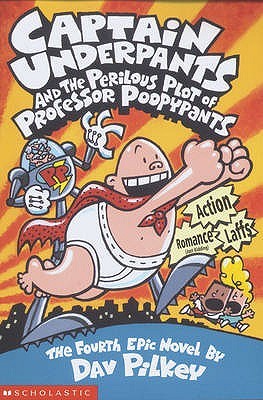 Captain Underpants and the Perilous Plot of Professor Poopypants by Dav Pilkey
I'm sure if you haven’t heard of Captain Underpants yet then by the end of this coming year you'll be saturated by him. Dreamworks are making a movie of him for summer 2017, and the villain is the superbly named Prof Poopypants. Dav Pilkey got the mix just right, with toilet gags, superheroes, mean principles, and two likeable heroes in the form of George and Harold. There's a nice subversive streak in the books, which I think appeals to the kids. Henry loves these books, and it inspired him to draw and scribble his own cartoons with writing underneath (the Adventures of Stinky and Henry if you're curious).
 The Jolley-Rogers and the Cave of Doom by Jonny Duddle
Is there a six-year-old not into pirates? Not in our neighbourhood. This series is about a girl Matilda who befriends a family of pirates who take residence in the port of Dull-on-Sea. What makes the series is the clever plots, the gentle and occasional deadpan humour, and the wonderful illustrations. Of the latter, the style is perfect and I'd struggle moving through the book as I'd be looking at the great pictures.

Horrid Henry and the Mega-Mean Time Machine by Francesca Simons
I'd read the HH books with my eldest, and so it was with great satisfaction that I coerced my Henry into reading about his namesake, with over half the 24 books saved in our study! There's so many to choose from, but this one is probably our favourite as the four stories are all great: notably the title story, and the trip to Restaurant Le Posh. As well as Henry and his naughty tricks, the collection of supporting characters (especially poor Perfect Peter) really shine in this book. And Henry's trick is really funny in this book, even for adults determined to ease their kids down the Peter way of life rather than the Henry one.
 The Brilliant World of Tom Gates by Liz Pichon
This one reminded me of an English version of Diary of a Wimpy Kid, which I enjoyed reading with my eldest years ago. It didn't quite have the bite of the Wimpy Kid, but Henry really enjoyed it as it balances the easy-going story with plenty of doodles and cartoons. It looks more like a diary than Wimpy Kid and had some moments of genuine well-observed family humour that adults would chuckle about. We've bought another two in the series for Xmas, so let's see if Santa comes up with a winning series for Henry on Xmas day.
 So those are the five top chapter books (and series) on Henry's shelves. Naturally, we still have short picture books that now he can read alone a little he's returning to (Oliver Jeffers awesome illustrations, both in his own books and in the Day the Crayons Quit are my personal faves), but more and more it's the chapters books he's loving. And I'm wondering how long I can stretch the bedtime stories out for, and who knows maybe he'll return the favour when my eyesight's gone and I'm in the mood for a chapter book or two!
Have a great yuletide, and I hope Santa brought you plenty of books.
Get even more book news in your inbox by signing up for our newsletter: http://eepurl.com/mHTVL. Girl Who Reads is an Amazon advertising affiliate; a small commission is earned when purchases are made at Amazon using any Amazon links on this site. Thank you for supporting Girl Who Reads.

One of the things I missed when my eldest two children got to that stage when they became independent readers was the bedtime story. Sure, at times, it could be a chore, especially when you have a dozen things still to do in that sacred 'kids in bed' period in the evening. But when it was gone, it left a void—and so when we were blessed with a third child and an age gap of six years—I was grateful for the return of bedtime stories.
I was chatting with my six-year-old, Henry, the other day about what books he's enjoyed the most. This last year he's progressed onto 'chapter books' as he calls them, and this has opened up a cornucopia of great reads. And given that it's the festive season, and anyone with kids/ nephews/ nieces/ grandkids are always eager for recommendations I thought I'd give you the top five from the brain of a six-year-old lad.
I truly can't quantify how awesome these books are. The chaotic illustrations and bizarre storylines are reminiscent of Roald Dahl books, and there are scenes that are seriously hilarious. It also has the vibe of something that just wouldn't do well filmed, which makes it extra special in my eyes! Mr Gum is the villain of the piece, with his grotty habits and his naughty schemes, he spends his days plotting the downfall of the village of Lamonic Biber. In this, the second book, the heroes are joined by the eccentric billionaire gingerbread man (powered by electric limbs), Alan Taylor. Alan must learn important lessons about value and wealth, in a suitably irreverent way. Just great.
I'm sure if you haven’t heard of Captain Underpants yet then by the end of this coming year you'll be saturated by him. Dreamworks are making a movie of him for summer 2017, and the villain is the superbly named Prof Poopypants. Dav Pilkey got the mix just right, with toilet gags, superheroes, mean principles, and two likeable heroes in the form of George and Harold. There's a nice subversive streak in the books, which I think appeals to the kids. Henry loves these books, and it inspired him to draw and scribble his own cartoons with writing underneath (the Adventures of Stinky and Henry if you're curious).
Is there a six-year-old not into pirates? Not in our neighbourhood. This series is about a girl Matilda who befriends a family of pirates who take residence in the port of Dull-on-Sea. What makes the series is the clever plots, the gentle and occasional deadpan humour, and the wonderful illustrations. Of the latter, the style is perfect and I'd struggle moving through the book as I'd be looking at the great pictures.
Horrid Henry and the Mega-Mean Time Machine by Francesca Simons
I'd read the HH books with my eldest, and so it was with great satisfaction that I coerced my Henry into reading about his namesake, with over half the 24 books saved in our study! There's so many to choose from, but this one is probably our favourite as the four stories are all great: notably the title story, and the trip to Restaurant Le Posh. As well as Henry and his naughty tricks, the collection of supporting characters (especially poor Perfect Peter) really shine in this book. And Henry's trick is really funny in this book, even for adults determined to ease their kids down the Peter way of life rather than the Henry one.
This one reminded me of an English version of Diary of a Wimpy Kid, which I enjoyed reading with my eldest years ago. It didn't quite have the bite of the Wimpy Kid, but Henry really enjoyed it as it balances the easy-going story with plenty of doodles and cartoons. It looks more like a diary than Wimpy Kid and had some moments of genuine well-observed family humour that adults would chuckle about. We've bought another two in the series for Xmas, so let's see if Santa comes up with a winning series for Henry on Xmas day.
Have a great yuletide, and I hope Santa brought you plenty of books.
Ross Kitson is a doctor, occasional blogger, full-time geek, and sporadic author of fantasy and YA sci-fi. Connect with Ross on Twitter. Read Ross's articles.
Get even more book news in your inbox by signing up for our newsletter: http://eepurl.com/mHTVL. Girl Who Reads is an Amazon advertising affiliate; a small commission is earned when purchases are made at Amazon using any Amazon links on this site. Thank you for supporting Girl Who Reads.
October 26, 2016
From Tiara to Tough Guy, the Rise of Luke Cage
by Ross Kitson
The latest installment in the great Netflix-Marvel partnership is Luke Cage, and it follows on with the mature style that the current TV adaptations of the Marvel Universe have set. Fortunately for my 14-year-old son the producers have opted to run it as a '15' (which is an R in the US) as per Jessica Jones and Daredevil season 1, rather than the uber-violent Daredevil season 2's '18.'
Those who read my posts will be aware that (a) I'm a happy superhero and comic-loving geek, and (b) I'm a big fan of what they're doing on Netflix. Of the latter point, it's telling that the guys behind Stranger Things went through a dozen studios before settling with Netflix. And what further marks of quality do you need beyond House of Cards, The Killing, and Narcos? Truly Netflix is on the verge of rivaling the remarkable HBO and AMC.
What I loved about Luke Cage was that they took a fairly B-movie hero (agreeably who had a boost in recent years by being in the New Avengers team) and did him perfectly. Here was a Black-American superhero, whose origins in the comics were firmly entrenched in the mires of 70s stereotype (afro, tiara, open-neck yellow shirt, lots of talk like 'jive'). The comic had a burst of popularity in the 'Blaxploitation' era, whilst the cinemas were replete with Superfly, Shaft, and Cleopatra Jones, but its odd mix of lighter comedic tone with gritty street-level setting meant that the comic-line ultimately merged with another (Iron Fist) to sustain it. This partnership, of invulnerable dude, Cage, and martial-artist, Iron Fist, was surprisingly readable—and I recall really enjoying it during my childhood in the late 70s to early 80s.
The duo were put out to pasture in the mid-80s when every Marvel comic not involving the letter X or with mature undertones was felt to be passé. Luke Cage was relaunched with a newer modern look in the 90s, and after a few stop-re-starts came under the magical pen of Brian Michael Bendis, whose runs on the Avengers, and gift for big cross-over events brought Luke back into the mainstream (not least in the mature title, Alias, which Jessica Jones is based on).
So how to reflect this chequered forty year history on the small screen? Well, the first move was to give Luke some space and a fresh backdrop. We find he's left Hell's Kitchen (where he appeared in Jessica Jones), and settled in Harlem. This was a smart move, as there are few other areas as intrinsically linked with Black American culture as Harlem. And the writers exploit this to its full potential, using the characters, and the history, and the vibe of the setting to frame the struggle of moralistic Luke against the villains of the tale.
The story is solid enough—nothing exceptional, with the necessary origin episode, some unresolved past issues, a few revelations and surprises, and a pretty effective finale. It shines for me in three ways, however.
Firstly, the series felt far more a part of the Marvel Universe than the prior three Netflix series. The Avengers were referenced repeatedly: the dude with the hammer, the big green guy, and even Captain America by name, are all mentioned. The use of Justin Hammer's tech is a great inclusion. More than the other series it examines the nature and effect of a hero, and a vigilante, whose identity is not a secret.
The second stand-out is the music. Just superb. Ideally chosen for the setting of Harlem, it mixes soul with rap with funk. The guest appearances by Method Man and Delfonics set the tone, and the soundtrack had some excellent songs from Issac Hayes, Ol' Dirty Bastard, Rakim, Wu Tang Clan, Gang Starr, and even Nina Simone and John Lee Hooker. Given that the soundtrack was such a big deal with Stranger Things, Netflix's huge success of the summer, I think that we'll find that the soundtracks become significant features in these series.
My final love of the series was the representation of black American culture. Given the style of the series, a black superhero, it could have so easily gone wrong. I was expecting a portrayal of gangstas battling Luke with escalating tech, and some black stereotypes tossed in. But the portrayals in this series were some of the best I've seen since the Wire, with well-rounded and intricate characters providing enough variety. And the writing was saturated with pop culture references, whether the jokes about kung-fu films, Shaft, Different Strokes, Dr Seuss, The Warriors, or the answer to 'who you goin' to call?' being... well... Ghostbusters! And Diamondback's reminiscing about being the Son of a Preacher Man, with Dusty Springfield playing. Just little touches that lifted the entertainment level above Jessica Jones and DD for me.
So, all in all, a huge success and setting the bar even higher for the next series, Iron Fist, which surely has to feature Luke, and the spin-off Punisher series. And in the cinema, we have Dr Strange almost here, and then Guardians of the Galaxy 2, with Spiderman: Homecoming soon after. It's a great time to be a Marvel fan, and DC need to really up their game! Perhaps Wonder Woman or Justice League will be what they need….
Ross Kitson is a doctor, occasional blogger, full-time geek, and sporadic author of fantasy and YA sci-fi. Connect with Ross on Twitter.
Get even more book news in your inbox by signing up for our newsletter: http://eepurl.com/mHTVL. Girl Who Reads is an Amazon advertising affiliate; a small commission is earned when purchases are made at Amazon using any Amazon links on this site. Thank you for supporting Girl Who Reads.
 |
Image from
|
Those who read my posts will be aware that (a) I'm a happy superhero and comic-loving geek, and (b) I'm a big fan of what they're doing on Netflix. Of the latter point, it's telling that the guys behind Stranger Things went through a dozen studios before settling with Netflix. And what further marks of quality do you need beyond House of Cards, The Killing, and Narcos? Truly Netflix is on the verge of rivaling the remarkable HBO and AMC.
What I loved about Luke Cage was that they took a fairly B-movie hero (agreeably who had a boost in recent years by being in the New Avengers team) and did him perfectly. Here was a Black-American superhero, whose origins in the comics were firmly entrenched in the mires of 70s stereotype (afro, tiara, open-neck yellow shirt, lots of talk like 'jive'). The comic had a burst of popularity in the 'Blaxploitation' era, whilst the cinemas were replete with Superfly, Shaft, and Cleopatra Jones, but its odd mix of lighter comedic tone with gritty street-level setting meant that the comic-line ultimately merged with another (Iron Fist) to sustain it. This partnership, of invulnerable dude, Cage, and martial-artist, Iron Fist, was surprisingly readable—and I recall really enjoying it during my childhood in the late 70s to early 80s.
The duo were put out to pasture in the mid-80s when every Marvel comic not involving the letter X or with mature undertones was felt to be passé. Luke Cage was relaunched with a newer modern look in the 90s, and after a few stop-re-starts came under the magical pen of Brian Michael Bendis, whose runs on the Avengers, and gift for big cross-over events brought Luke back into the mainstream (not least in the mature title, Alias, which Jessica Jones is based on).
 |
Image from http://www.marvel.com
|
The story is solid enough—nothing exceptional, with the necessary origin episode, some unresolved past issues, a few revelations and surprises, and a pretty effective finale. It shines for me in three ways, however.
Firstly, the series felt far more a part of the Marvel Universe than the prior three Netflix series. The Avengers were referenced repeatedly: the dude with the hammer, the big green guy, and even Captain America by name, are all mentioned. The use of Justin Hammer's tech is a great inclusion. More than the other series it examines the nature and effect of a hero, and a vigilante, whose identity is not a secret.
 |
Image from http://www.imdb.com/title/tt3322314/
|
The second stand-out is the music. Just superb. Ideally chosen for the setting of Harlem, it mixes soul with rap with funk. The guest appearances by Method Man and Delfonics set the tone, and the soundtrack had some excellent songs from Issac Hayes, Ol' Dirty Bastard, Rakim, Wu Tang Clan, Gang Starr, and even Nina Simone and John Lee Hooker. Given that the soundtrack was such a big deal with Stranger Things, Netflix's huge success of the summer, I think that we'll find that the soundtracks become significant features in these series.
My final love of the series was the representation of black American culture. Given the style of the series, a black superhero, it could have so easily gone wrong. I was expecting a portrayal of gangstas battling Luke with escalating tech, and some black stereotypes tossed in. But the portrayals in this series were some of the best I've seen since the Wire, with well-rounded and intricate characters providing enough variety. And the writing was saturated with pop culture references, whether the jokes about kung-fu films, Shaft, Different Strokes, Dr Seuss, The Warriors, or the answer to 'who you goin' to call?' being... well... Ghostbusters! And Diamondback's reminiscing about being the Son of a Preacher Man, with Dusty Springfield playing. Just little touches that lifted the entertainment level above Jessica Jones and DD for me.
 |
Image from http://comicvine.gamespot.com
|
Ross Kitson is a doctor, occasional blogger, full-time geek, and sporadic author of fantasy and YA sci-fi. Connect with Ross on Twitter.
Get even more book news in your inbox by signing up for our newsletter: http://eepurl.com/mHTVL. Girl Who Reads is an Amazon advertising affiliate; a small commission is earned when purchases are made at Amazon using any Amazon links on this site. Thank you for supporting Girl Who Reads.
August 24, 2016
Stranger Days
by Ross M. Kitson
It should come as no surprise to those that read my alternate monthly blog that Stranger Things was a massive hit with me. For those who haven’t seen the smash Netflix hit of the summer, it tells the tale of mid-80s rural America and four young friends, one of whom goes missing. The story unfolds as a homage to 80s sci-fi horror a la John Carpenter and Stephen King, with a dash of Spielberg BMX riding fun to glue it together.
Now apart from the obvious nostalgia value for me (with regards the music, style and every 80s film I ever loved) you’d be wondering why a Brit growing up in Northern England (just south of the Wall) in the early 80s would relate to somewhere in the US mid-west with an alcoholic sheriff called Hopper? Well the clatter of polyhedral dice and the furious debate about whether to fireball or defend against the Demogorgon should solve that mystery as quick as Scooby Doo. Dungeons and Dragons, in all its first edition glory. (If you haven’t watched the series yet, be wary of some minor spoilers below!)
I blogged in June about my childhood love of the hobby, and the influence it had on my writing, and indeed the writing of many others. Undoubtedly it had similar influences on the Duffer brothers who wrote and directed the eight episode story.
The first five minutes of episode 1 capture much of what invigorated so many with the hobby: the friendships, the excitement, the imagination. As a narrative device it works perfectly for the series.
The three remaining friends use their interest in fantasy and science fiction to rationalise the increasingly bizarre events of psychic powers, parallel universes (explained brilliantly), and… monsters. The repeat reference to the monster as ‘Demogorgon’ is a real nod to the 1st Edition DnD, before concern that all fantasy gamers were Satanists purged the following editions of demons and devils. In the version played in the show, Demogorgon is the Prince of all demons, in the lowest levels of the Abyss. His two mandrill heads and tentacles made for an awesome miniature, which was slammed onto the table in that epic first minute of the show, and that reappeared as a way of explaining ‘monsters’ to El in a later episode. To the players it is the ultimate monster to be conquered, and the banter between the friends is whether against such a creature it is better to defend or attack. It is this dilemma that drives the series through to its incredible finale.
In my childhood experience of DnD, I only experienced a mild amount of teasing and mockery. Our close-knit group who played, both when I lived in Leeds and later Peterborough, weren’t especially ‘outcasts’ or ‘alternative.’ Perhaps at that time, the UK was more acceptant of stranger hobbies. We all collected comics, loved sci-fi, played DnD, some had computers (ZX Spectrums, Atari, VIC 20s), most of us liked music we taped off the radio. The bullying that the three friends experience in the show is only partly related to their love of DnD, in that it gives the bullies recourse to call them names and mock their close friendships.
And of course, the general perception of DnD at the time in both UK and the US wasn’t entirely rosy. Much in the way that the moral majority rallied against heavy metal music, alleging its influence on the youth of America’s moral upbringing, mental stability and suicide rates, DnD came into the righteous cross-hairs. The now infamous Jack Chick comic strip, Dark Dungeons, tells the tale of Debbie whose participation in DnD games led to her involvement in a coven mainly to get her father to buy DnD books and miniatures. The DnD provoked suicide of a friend then brought Debbie back to Christianity and redemption. The strip culminates in a good old book burning, perhaps with some Harry Potter books tossed on to help the pyre (of course I’m being facetious, as Harry Potter book burning was a product of more recent enlightened times).
As amusing as it seems now, there was serious anti-DnD propaganda back in the 80s, and even the famed Tom Hanks starred in the TVM Mazes and Monsters in 1982, wherein a latent psychotic illness is unlocked by the fantasy game, Mazes and Monsters, with tragic results. The film was based mainly on the sensationalism surrounding the disappearance of a student at MSU. The 80s were replete with pressure groups against DnD, in some cases driven by religious sentiments and the perception of DnD as an occult phenomenon, and in some cases bereavements and tragedy. Authors jumped on the bandwagon, associating a horrific murder with the fact the perpetrator (Chris Pritchard) was a Dungeon Master (and playing down his drug and alcohol addiction, and desire to inherit $2 million).
Yet most studies don’t indicate that players of role playing games have any higher rates of mental illness, suicide, or depression, but such studies are often ignored in the media. Did it appeal to the geekier cross-section of society? Certainly, as back then they would have been the ones with the imaginations, and the creativity to enjoy it fully. Nowadays these would be the same children and teenagers stereotyped as gamers, the same ones unfairly mocked about hunting Pokemon, by a society determined to deride anyone else’s interests and fun!
Yet it is these traits, of imagination, creativity, and ultimately comradery and friendship which are the core of the heroes in Stranger Things. It’s these characteristics that lead them to accept El, and to search for their missing friend when everyone else has given up. And that’s the message in Stranger Things, and that’s one of the keys to its success—Demogorgon or no.
(As an end-note, the series has got my kids fired up about playing old school DnD again, ironically dragging them away from the aforementioned Pokemon!!).
Get even more book news in your inbox by signing up for our newsletter: http://eepurl.com/mHTVL. Girl Who Reads is an Amazon advertising affiliate; a small commission is earned when purchases are made at Amazon using any Amazon links on this site. Thank you for supporting Girl Who Reads.
It should come as no surprise to those that read my alternate monthly blog that Stranger Things was a massive hit with me. For those who haven’t seen the smash Netflix hit of the summer, it tells the tale of mid-80s rural America and four young friends, one of whom goes missing. The story unfolds as a homage to 80s sci-fi horror a la John Carpenter and Stephen King, with a dash of Spielberg BMX riding fun to glue it together.
 |
| Image from hellogiggles.com |
 |
| Image from ew.com |
The first five minutes of episode 1 capture much of what invigorated so many with the hobby: the friendships, the excitement, the imagination. As a narrative device it works perfectly for the series.
 |
| Demogorgon figure image from bustle.com |
In my childhood experience of DnD, I only experienced a mild amount of teasing and mockery. Our close-knit group who played, both when I lived in Leeds and later Peterborough, weren’t especially ‘outcasts’ or ‘alternative.’ Perhaps at that time, the UK was more acceptant of stranger hobbies. We all collected comics, loved sci-fi, played DnD, some had computers (ZX Spectrums, Atari, VIC 20s), most of us liked music we taped off the radio. The bullying that the three friends experience in the show is only partly related to their love of DnD, in that it gives the bullies recourse to call them names and mock their close friendships.
And of course, the general perception of DnD at the time in both UK and the US wasn’t entirely rosy. Much in the way that the moral majority rallied against heavy metal music, alleging its influence on the youth of America’s moral upbringing, mental stability and suicide rates, DnD came into the righteous cross-hairs. The now infamous Jack Chick comic strip, Dark Dungeons, tells the tale of Debbie whose participation in DnD games led to her involvement in a coven mainly to get her father to buy DnD books and miniatures. The DnD provoked suicide of a friend then brought Debbie back to Christianity and redemption. The strip culminates in a good old book burning, perhaps with some Harry Potter books tossed on to help the pyre (of course I’m being facetious, as Harry Potter book burning was a product of more recent enlightened times).
 |
| The unfortunate Debbie in Dark Dungeons. Image from http://www.therobotspajamas.com/dd-kills-with-the-help-of-satan/ |
Yet most studies don’t indicate that players of role playing games have any higher rates of mental illness, suicide, or depression, but such studies are often ignored in the media. Did it appeal to the geekier cross-section of society? Certainly, as back then they would have been the ones with the imaginations, and the creativity to enjoy it fully. Nowadays these would be the same children and teenagers stereotyped as gamers, the same ones unfairly mocked about hunting Pokemon, by a society determined to deride anyone else’s interests and fun!
Yet it is these traits, of imagination, creativity, and ultimately comradery and friendship which are the core of the heroes in Stranger Things. It’s these characteristics that lead them to accept El, and to search for their missing friend when everyone else has given up. And that’s the message in Stranger Things, and that’s one of the keys to its success—Demogorgon or no.
(As an end-note, the series has got my kids fired up about playing old school DnD again, ironically dragging them away from the aforementioned Pokemon!!).
Ross M Kitson, features writer. Ross is a doctor, occasional blogger, full-time geek, and sporadic author of fantasy and YA sci-fi. Connect with Ross on Twitter.
Get even more book news in your inbox by signing up for our newsletter: http://eepurl.com/mHTVL. Girl Who Reads is an Amazon advertising affiliate; a small commission is earned when purchases are made at Amazon using any Amazon links on this site. Thank you for supporting Girl Who Reads.
Subscribe to:
Posts (Atom)


 Posts
Posts


