Readers' Favorite

June 23, 2016

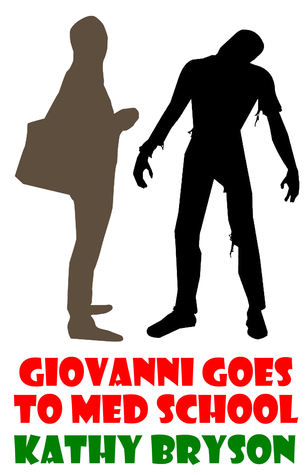
Review: Giovanni Goes to Med School by Kathy Bryson

by Claire Rees

Giovanni Goes to Med School
Giovanni is a typical medical student. He is doing well in his position at the hospital but with his debt growing out of control he decides he needs to get a job; any job he can get, and at this moment in time it's in the hospital morgue. The night shift. Away from the weird morgue manager, who seems to be eager to get away from the place.

The job should be easy right? All of the patients are dead, and do not really require any attention.

At first all is going great, everything is quiet until one of his dead patients becomes the undead, she is sitting up, walking around and talking to him, making sure her dog is ok. But is also starting to decompose and is causing all sorts of problems.

He doesn't tell anyone because who would believe him? that is until after a few macabre meetings and a run in with another med student who he can share his concerns too and introduce to his horrifying visitor.

An enjoyable read and far from any other zombie story I've ever read.

I would recommend this to all zombie lovers to get a feel of a different type of zombie tale.

Buy Giovanni Goes to Med School at Amazon


Claire Rees, reviewer. Claire lives in a small village in the South Wales Valleys, UK with her husband, two kids and five snakes. She will hopefully be starting an English literature course this September. She has always loved reading books. Her favorite genres are horror, mystery and fantasy, although if the story line is good she'll read anything. Connect with Claire on Facebook.


Book info:
available formats: ebook (70 pages)
published: March 2016
genres: fantasy, humor


Get even more book news in your inbox by signing up for our newsletter: http://eepurl.com/mHTVL. Girl Who Reads is an Amazon advertising affiliate; a small commission is earned when purchases are made at Amazon using any Amazon links on this site. Thank you for supporting Girl Who Reads.

June 22, 2016

D and D and me

by Ross M. Kitson

I blogged a while ago (on my random mescaline-addled blogspot) about inspirations that have guided my writing--and within that is not just my fantasy work, but my YA sci-fi story currently pending its sequel. The blog noted the key influence of comics in my style, focusing particularly on the work of John Byrne.

But if I had to cite one key formative step in my writing there is no doubt that it would be role playing games, and of them all (and believe me I played almost all of them in the Eighties) it has to be Dungeons and Dragons.

This will come as no surprise to those who read my work, and indeed the influence of DnD can be seen in many top fantasy authors currently. This is a strange full circle: fantasy books inspiring a game, a game engaging and inspiring potential authors, who then write fantasy!

Art by Dave Trampier from 1st Edition
DMG  (pub TSR)
I first observed the DnD phenomenon via my mate Nick Earnshaw's brothers' piles of DnD stuff. They were placed around his house, in little piles, under tables and cabinets- enticing mounds of graph paper, funny dice, rule books and modules. This was in c1981 and thus we are talking old school first edition AD&D here. I properly got into it when (a) I started on the Fighting Fantasy books and (b) got intrigued by The Hobbit and Lord of the Rings. Ralph Bakshi had released a cartoon of LOTR and I recall seeing a recovered LOTR book at my mate's house (and indeed, we later played Middle Earth RPG). I started, as many did, on Basic D&D, moving onto Expert and from that, Advanced. I spent my life savings (about £30) on the Dungeon Masters Guide and the Players Handbook, doing without the Monster Manual for  year or so (creating many odd interpretations of the monsters found in that big table in the appendix of the DMG).

And the creativity began. We played a lot of the modules at first: The Giant and the Drow ones (G1-3, D1-3, Q1) I ran with my younger brother. We played White Plume Mountain about ten times over (how cool was Black Razor? Like bloody Storm Bringer), Tomb of Horrors, one of the A ones (I forget which) and... as time went on, and the adventures got cooler, the UK modules and Dragonlance (and of course, Ravenloft).

But the real fun in the game was the real creativity--the writing of my own adventures, the generation of a campaign. Although through the Eighties we played dozens of other RPGs (Runequest, Traveller, Star Frontiers, Gamma World, Call of Cthulhu, Paranoia, Dr Who, Star Trek, MERPG, Toon, Judge Dredd, Bushido, Marvel Superheroes, Villians and Vigilantes, the time travel one, a gangster one too....) DnD was always my favourite. What we created changed with our tastes, or maturity and our outside influences. In the beginning it was daft, far-fetched, almost cartoonish--I recall a repeat-action crossbow that we loved in Hawk The Slayer, that half the characters had. Later we would weave together intricate campaigns, with fully realised histories.
Cover of 1st Edition Players Handbook
(published by TSR)

I was never one for using TSRs campaign worlds (Greyhawk, Forgotten Realms) although when I ran a campaign in 1988-1991 I used the Fighting Fantasy sourcebook Titan as the basis for the adventures. But the story became personal, almost like a soap opera, with marriages, kids, relationships. old family feuds, arch-enemies and recurrent villains. Like a story, like a RPG should be.
Then I hit medical school, and we all moved apart in the country. Bar one or two sessions we all accepted that we'd not play again and, when wives and kids arrived, it seemed even less likely.
Around 8 years ago, bored one evening, I began to write a quick story about the characters we used to play with. I e-mailed it out to the guys and they loved it, and so I began to write a story as if we were playing the adventures again, with all the references to the characters histories.

It felt great, creating once more, breathing life into dialogue and action. The 300 pages the story ran to taught me a huge amount about writing, about structure. As it was concluding one of my mates, Ant, commented that I should tackle something brand new... something not related to our prior campaign.

Module S2: White Plume Mountain
(Published TSR)
So it began with a map... and now it’s a six book saga, which I’ve finally finished over a six year period.
It took a while to escape the complete DnD influence. The first draft was very DnD style, with the magic derivative, and the characters almost having classes and levels! It took a bit of discipline and merciless use of the Red Pen of Sorrow +1 to tame the bias in the text.

But despite the modifications and moderations, it is unashamedly a book written by a DnD player (and Dungeon Master). I'm proud of that fact, and proud that I'm now starting a campaign with my kids (aged 10 and 8)... and White Plume Mountain awaits....
I’m not alone in this. There are a dozen famous fantasy authors whose work is heavily influenced by DnD: Erikson, Scott Lynch, Parick Rothfuss, Saladin Ahmed, Peter Brett, China Meville, and George RR Martin. The influence has drifted out to literary circles beyond fantasy, including Stephen Colbert, and Junot Diaz.
In many ways the playing of DnD emulates that of the traditional storyteller, sat around a campfire, with the added influence of improvised theatre thrown into the mix, and despite the rise of computer role playing systems and the internet it remains a popular outlet for creativity and expression some four decades after its inception.

Ross M Kitson, features writer. Ross is a doctor, occasional blogger, full time geek, and sporadic author of fantasy and YA sci-fi. Connect with Ross on Twitter.


Get even more book news in your inbox by signing up for our newsletter: http://eepurl.com/mHTVL. Girl Who Reads is an Amazon advertising affiliate; a small commission is earned when purchases are made at Amazon using any Amazon links on this site. Thank you for supporting Girl Who Reads.

June 21, 2016

Q&A with Kim Addonizio, author of BUKOWSKI IN A SUNDRESS


As you are, as you say, a writer occasionally tarred with the brush of being a “confessional poet,” readers often think that the details in your poems are entirely true. But here, you admit that you’re guilty of lying your head off in poems and that you “just plain make shit up.” With nonfiction—especially memoir—there’s an expectation from the reader that it has to be God’s honest truth. Is essay writing more difficult for you, given that you can’t get to the truth by “lying” the way you can in poetry and fiction?

Essays are definitely trickier. In a poem or a piece of fiction, I can change things to shape a story or an idea, or just make the whole thing up.  In an essay, I have to find the story in what actually happened.  The heart of the piece has to emerge out of memory and lived experience. The fidelity in a poem or story is to emotional truth.  That’s true in memoir, too, but I’m trying as much as possible to say what happened and how it felt. Though often it was less funny at the time.  It seems to me you can tell all the facts but still lie in terms of the emotion, and there’s a fine line when you’re using humor. The thing is, I do find much of my experience funny in retrospect. Thank God.


Were there any parts of your life that you felt were off limits for this memoir? How did you go about shaping the book?

Hey, even “confessional” writers have their secrets! That said, I was focused on how to structure the book around both writing and life, and giving weight to each of those things—which for me are so intertwined they often feel inseparable. I had a very different manuscript originally, one that revealed a lot about the ending of a long-term relationship.  It wasn’t until I hit on that writing/life dynamic that I was able to finish the book.  And now I’m glad all that other stuff didn’t end up being in it—partly because I didn’t want to be unkind to that person. Revenge memoirs probably aren’t a good idea.  You need to step back at a certain point.


Many of the essays in Bukowski in a Sundress explore the tender albeit fickle nature of familial relationships. You write about an estranged brother, the difficulties in caring for an aging mother, and striving to protect your own daughter from the world’s impurities (especially the erotica you once wrote for Penthouse). How has your family directly or indirectly informed your writing? 

Both my parents, as it happened, wrote books—my mother a tennis guide and her autobiography,  and my father a memoir called Sportswriter.  Writing was something I saw my Dad do, growing up.  He’d sit at the kitchen table typing his column for the Washington Post.  Yet literature wasn’t valued in our house.  It was my family’s focus on sports that led me to reading, where I found a world I could inhabit. Mostly I found my own way as a writer, without parental support or understanding of what I was aiming for (my father died as I was just starting down that road). Now that they’re both gone, the only person I worry about is my daughter, Aya. I guess she already knows most of my faults, but still. And then there’s the sex stuff, which no kid wants to read when it features a parent.


In addition to being a prolific writer, you’ve played harmonica in various bands. The relationship between music and writing—especially poetry—has long been a continuous one. Does focusing your creative energy on other arts like music affect your writing process, or is it more of an escape? 

Music, especially the blues, has definitely influenced my poetry and my performance of it. I don’t think that’s true of my prose. And music is also, definitely, an escape sometimes, a room to go into when the writing isn’t happening. Studying music also reminds me of how much work goes into any creative endeavor, and reminds me that if I keep working, I’ll get closer to solving the problems of a particular piece of writing.


You were once characterized as “Charles Bukowski in a sundress.” Given the level of regard Bukowski is afforded in prestigious literary circles, it’s hard to believe the comparison was meant as a compliment. In the collection, you express your preferences for other characterizations, like “Gerald Manley Hopkins in a bomber jacket,” “Walt Whitman in a sparkly tutu,” or “Emily Dickinson with a strap-on.” Are you still adverse to the Bukowski comparison? How do you confront the unfair, petty, or sometimes belittling criticisms that writers often face, especially women writers?

Of course I’m being facetious about those comparisons. I guess it’s human nature to put people into categories—which is useful, but can be limiting or reductive. I’m always open to honest criticism. As for unfair, petty, and belittling critics, I say, Fuck you. Because that’s what they’re saying to me. And yes, women writers—don’t get me started! Right now I’m rereading Rebecca Solnit’s Men Explain Things to Me. She talks about silencing and “the necessity of making women credible and audible.” That’s what it’s about, on the personal, the cultural, the societal level. We could bring race and class and sexuality into this, too. Why was #BlackLivesMatter necessary? Because everyone knows that those lives, in so many ways that play out every day, don’t matter as they should.


You write candidly about your romantic relationships. What was it like to commune with the ghosts of relationships past? Did you gain any new insights into these men or yourself in the process?

Maybe this circles back, in some way, to the first question about “God’s honest truth.” There’s so much left out of all of those stories, and while they’re true, it’s impossible to tell, or understand, the whole story of those relationships and what they meant. I’m an awfully slow learner in terms of romantic love. I don’t seem to know how to make it work. It would help, for starters, if I knew how to get a date with someone who was actually in the ballpark.  The men I’ve encountered in the past few years aren’t even in the parking lot having a tailgate party. That probably, actually, says a lot about the work I’ve got to do on myself.  But I’m lazy that way. I’d rather write.

Buy Bukowski in a Sundress at Amazon


About the Author:
Kim Addonizio is an award-winning author of fiction, essays, and poetry. She has received numerous honors for her work, including the John Ciardi Lifetime Achievement Award and fellowships from the Guggenheim Foundation and the National Endowment for the Arts. Her poetry collection Tell Me was a finalist for the National Book Award, and she has won Pushcart Prizes for both poetry and prose. She is also the author of two hugely successful guides for beginning poets, The Poet's Companion and Ordinary Genius, and has taught writing workshops in New York City, the Bay Area, and at conferences across the country.
Twitter  *  website


Get even more book news in your inbox by signing up for our newsletter: http://eepurl.com/mHTVL. The views, opinion and beliefs expressed by guests are their own and do not necessarily reflect those of Girl Who Reads. Girl Who Reads is an Amazon advertising affiliate; a small commission is earned when purchases are made at Amazon using any Amazon links on this site. Thank you for supporting Girl Who Reads.

June 20, 2016

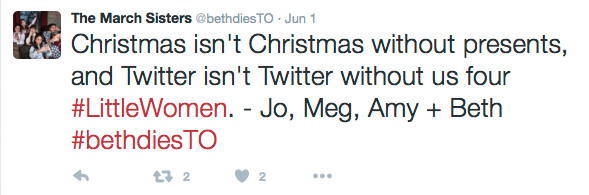
Jo March (of Little Women) is Now on Twitter, and She’s Hilarious #MondayBlogs

by Katie Meyer


A lot has changed for 20-something women since the world first met the March sisters in 1865—but some issues remain the same. The little women Jo, Amy, Beth and Meg are more relatable as ever, especially since they joined Twitter as @bethdiesTO. For bookworms, @bethdiesTO is the perfect satire to follow.


With @bethdiesTO, you can now tweet to your favourite literary family. That is, if the March sisters can take a break from scrambling for money and plotting their escapes from Concord. The Twitter feed is a mashup of Little Women and the show Girls, recasting the troubles of the March sisters in hi-larious contemporary voices.


The satirical Twitter account is part of the Toronto Fringe production of the play Women, a laugh-out-loud satire of Little Women that won a New York Times Critics Pick. @bethdiesTO, like the play it’s based on, shows us that some struggles for women are eternal. Fighting with your sisters and avoiding advances from a creepy neighbour were major pains for women in 1865, and they still are 2016.

@bethdiesTO also reminds followers that a lot has changed for 20-somethings. Beth’s feminine ideal of a charitable spirit seems less darling when they’re so poor that Jo has to sell her hair to buy a train ticket.


Want to support the March sisters? You can chip in to their crowdfunding campaign to help this production of Women purchase costumes and print programs for Toronto Fringe. And if you’re lucky enough to live in Toronto, you can meet the March sisters in person from June 30 to July 9 at Annex Theatre. You don’t have to sell your hair to see the play—tickets are just $12.

Talking with your favourite heroines of fiction is a rare opportunity, and on Twitter, the March sisters are pretty chatty. You can reach out to Beth, Amy, Meg and Jo by tweeting to @bethdiesTO or tweeting with the hashtag #bethdiesTO. SPOILER ALERT: Beth, bless her heart, doesn’t make it.


Get even more book news in your inbox by signing up for our newsletter: http://eepurl.com/mHTVL. Girl Who Reads is an Amazon advertising affiliate; a small commission is earned when purchases are made at Amazon using any Amazon links on this site. Thank you for supporting Girl Who Reads.

June 19, 2016

Reissue of Fantastic Series

by Susan Roberts

Prime Time
Prime Time is the first book in Hank Phillipi Ryan's Charlie McNally series that has been updated and re-released in February of this year. Ms. Ryan is a new author for me but after totally enjoying Prime Time, I am anxious to read the rest of the books in this series and read her other books, too.

Charlotte "Charlie" McNally is an investigative reporter for a TV station in Boston. At 46, she is worried that she will soon be replaced by a younger news reporter. Sweeps week is coming up and she's being pressured to come up with a big story. Even though she has Emmy Awards and has had a successful career, she knows that the next story is always the most important. Her reporter instincts lead her to a story that may be the best story of her life if she is successful or it may cause her to lose her life if she isn't. It's a definite mystery and the ending was a real surprise to me.

What I liked most about this novel was the main character of 'Charlie'. It's so nice to read a book with an older female main character who has flaws and questions herself and her abilities like Charlie does. There are other good characters in the book but Charlie was the one that was the most real to me. I can't wait to see what happens to her in the next book in the series Face Time that came out in April. Air Time will be available in June and Drive Time in August.

Note: Prime Time won the Agatha Award for First Novel and the Romantic Times Reviewers Choice Award.

Buy Prime Time at Amazon


Face Time
Face Time is book 2 in the Charlotte McNally series and I  enjoyed this book as much as the first.

The characters are great and the story line has a lot of mystery and a little bit of romance.

Charlie is a TV investigative reporter on the wrong side of 40 in an industry where looking youthful matters a lot. Even though she has won Emmy awards for her stories, she is always questioning herself and her abilities even while she is always searching for the next big story. In this story, she is contacted by a local group to help prove that Dorinda Keeler, who confessed to the murder of her husband four years earlier, is really innocent. Even though she finds some information to show that Dorinda may be innocent, Dorinda won't talk and claims to be guilty. Charlie and her producer, Franklin, continue to work on the story to try to prove her innocence. Along with a powerful story line about guilt or innocence, throw in Charlie's mother who has just had plastic surgery (and thinks that her daughter  should be thinking about some plastic surgery, too) and Josh, her new love and his 8 year old daughter who isn't too excited to have Charlie in her dad's life.

This is a fun story and a great read. Books 3 and 4 can't get here soon enough!

Buy Face Time at Amazon


Susan Roberts, reviewer. Susan grew up in the Detroit area but after deciding that city life wasn't for her she moved to North Carolina after college. She and her husband have several acres of land and they enjoy gardening and canning vegetables in the summer. They travel extensively. Susan reads almost anything (and the piles of books in her house prove that) but her favorite genres are Southern fiction, women's fiction and thrillers. Susan is a top 1% Goodreads Reviewer. You can connect with Susan on Facebook or Twitter.


Get even more book news in your inbox by signing up for our newsletter: http://eepurl.com/mHTVL. Free books were provided by Tor/Forge Books for this review. Girl Who Reads is an Amazon advertising affiliate; a small commission is earned when purchases are made at Amazon using any Amazon links on this site. Thank you for supporting Girl Who Reads.
June 18, 2016

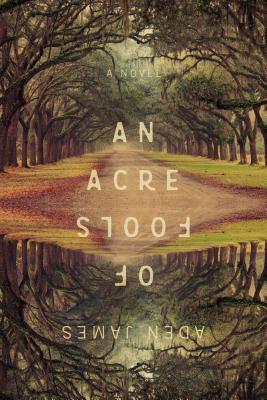
Review: An Acre of Fools by Aden James

by Donna Huber

An Acre of Fools
Do you ever pick up a book from your to read pile and wonder what attracted you to it? I kind of felt that way with An Acre of Fools by Aden James.

From the back cover,
After battling a long illness, Peter Stewart's daughter, Austin, finds herself in a nightmarish addiction that thrust her and her family into a world they never imagined.
As she buries herself deeper and deeper into the narcotics culture of shameless selfishness and deeply personal manipulation, Peter's unwavering hope for her drives a wedge between him and the less forgiving family members.
But when Austin finally chooses to embrace all that the life of addiction offers, Peter is forced to choose between his faith and a family too broken to hope.
He chooses poorly.
I guess I was drawn to the dysfunctional family and personal struggle. However, when I first started reading An Acre of Fools, I felt like I was reading a different book.

It starts off with a youngish couple from Chicago purchasing a vacation home on the Okatie River in South Carolina. Yes, it was a bit run down, but Mimi saw potential. She saw her dream life unfolding before her.

Almost the entire novel revolves around the one week a year they live in the house along the river. And in the beginning it seemed pretty idyllic.
Beginnings have a way about them that are so innocent, so pure. Endings can be so tragic and so corrupted, Somewhere in between is the mystery of life, the crooked journey that captures hearts and souls along the way. pg. 33.
But dreams have a way of not turning out quite as imagined and possibly even turning into a nightmare. While Mimi saw two boys playing along the riverbanks in her dream, her first born was a girl. But life was still good.

Then came along another child and instead of two little boys, Mimi would have two little girls playing along the river. But soon after Austin was born, it was evident that life wouldn't be as smooth sailing as before. Not because having a second child in tow causes that much more work, but because something was wrong with Austin. Something every wrong. Something that would take years for them to figure out and even longer to treat.

With each chapter comes a new year in the life of the Stewarts along the banks of the Okatie. Sometimes a year or two would have passed sometimes several. The reader is definitely treated to snap shots of the family's life. And like most pictures, they try to show the best of times.

And while there is definitely something special about the place along the Okatie, real life begins to encroach. By the time Austin is a teenager, she is addicted to the Oxycotin that she was prescribed for her serious illness. Life for the Stewarts would never be idyllic, innocent or pure again.

I really enjoyed James's writing style. While the story is about a family dealing with drug addiction, it is also so much more than that. So much so that at times I didn't think the story was really about this family's situation, but more about the internal battle of good versus evil. Some of James's best writing was when Peter was struggling with his faith. For Peter so desired to be the love of Christ to the world, yet he recognized the evil, the hatred, he held deep within his heart. The dialogue that Peter had with himself and others spoke so richly of the human condition that this story could have been anyone's story.

I really found this passage between Peter and his eldest daughter Gracie to be quite poignant.
They paddled in silence enjoying the scenery for a while, until Gracie asked her father, "Dad what do you believe?"
"Believe? About what?"
"About life. About God. About what's happened to our family."
"That's a very deep question for such a lazy day. Fo you really want to go there?"
"I do. With Austin out of our lives, I've been able to relax a bit, but now I miss our family, our whole family. The way we used to be. When we were young, I don't understand why God tore us apart."
"Do you want the complex Peter answer, or the quick and easy Dad answer?"
"We have time. I'd really like to know."
"Okay, then. For starters, I believe that Jesus of Nazareth is the Son of God. Through His grace we are saved. Not because of what we do, but because of what He did."
"Igot that. I know that. But that all sounds very churchy. Why are you so on-fire for Him given how hard our life has been?"
Peter thought for a moment. "Some people think that life is the easy stuff and the hard stuff gets in the way. The hatd stuff is part of life, it's part of the journey. The Bible says that we're going to have difficulties. But we should be of good cheer anyway."
"Why? why should we be cheerful with all we have to put up with, knowing what Austin's entire life has meant to both her and to us?"
"Let's look at it this way. I can sit in my chair at home and read about loving unconditionally, even loving my enemies. And I can gree with that from the comfort of my cozy room. But then put me with someone who is a pain to be around, or someone who is actually trying to hurt me and I'm probably not going to respond in a loving way. So, then I ask you, do I agree with the Word of God, or not?"
"Probably not."
"Exactly, You don't know what you believe in until you're given the opportunity to act upon it. So difficulties are actually oppportuniities to show you what you really believe, not just what you say you believe. It's God's way of helping you see things about yourself that you could never know when life is moving along easily.
"I believe in Jesus and His Word, in part, because, in the face of horrible persecution, He forgave those who were hurting HIm. He chose not to look at the persecution. He chose to look at how His actions would impact a man like me. So for Him, the difficulty was an opportunity to demonstrate love.
"A belief is nothing until you claim it through your own experience, until you hold firm to it through suffering. I can observe someone else's suffering and contemplate how I'd respond in the same sistuation. But until I actually suffer, I don't really know who I am.
"So both the good and bad are life, and how we responss determines what that life will be like in our experience of it. Two people can go  through the exact some trouble and have two very different views of life and two very different life experience. I choose to respond as Jesus both commanded me, and as He did Himself."
"What about a man like Jack? Do you forgive him?"
The question slugged Peter in the guy. It stopped him cold. Gracie could see how it visibily upset her father. pg 179-181
The conversation continues a bit about all sin being the same to God and how the Bible tells Peter that he must love Jack, though Peter sees him as the enemy.
"But, Dad, he almost killed you daughter. And now there are other men just like him who are also killing your daughter. How can you love people like that?"
"And now come the harder answer, my real answer to your question." Peter hung his head and hesitated to go on. But then he picked up his head and spoke with a viciousness that Gracie had never, ever seen in her father.
"I want to kill them all." pg. 181-182

I usually lean towards fluff reads in the summer, but I like to read at least one book that has some meat to it. And as you can see from the above passage, An Acre of Fools definitely gives the reader a lot to think about.

Peter's faith plays an important role in his life and the plot of the story, but I wouldn't necessarily consider it to be Christian fiction. I think anyone who holds strong beliefs grounded in peace and love will be able to identify with the struggle Peter faces.

Besides faith, another overarching theme in this book is why bad things happen to good people. In the passage I quoted, we get a glimpse of Peter's answer, but in the novel we also get answers from a few of the other characters.

I struggled with a few things in the story. Mostly timeline issues. I kept losing track of the kids' ages and I wasn't really sure when the book was set. There are clues, but I found them frustrating more than help.I eventually had to sit down and work out the timeline for myself. Did you know the first living donor liver transplant was done on November 27, 1989? Austin had one when she was about 5, with Peter being the donor, when it was still experimental.

The biggest timeline problem for me though came when Austin went to college. Now, she was a very sick child in the early years; she nearly died when she was about 8 (I think). Yet, she graduates high school when is is 17. That's not too unusual, but she doesn't turn 18 until February-ish. That would have meant she entered first grade when she was 5 and I'm pretty sure all school's require children to be 6 by Sept. 1 to enter 1st grade. Plus this would have been when she was most ill. Would she really have kept up with her school work? I know the story line wouldn't have worked quite as well, but things like that irk me.

Even with this issue, the story kept me up past my bedtime more than once as it was very addictive once you got into the story. The whole story is not gloomy or filled with philosphocial discussion. There are quite a few fun family moments that will endear you to this family and make you wish you had a house on the river to go to with your family.

By Townofbluffton (Own work)
[CC BY-SA 3.0], via Wikimedia Commons
If you are looking for a book that will make you reflect on your own beliefs and life choices, then I highly recommend An Acre of Fools. 


Buy An Acre of Fools at Amazon


Donna Huber, founder & publisher. Donna is an avid reader and natural encourager. She is the founder of Girl Who Reads and the author of how-to marketing book Secrets to a Successful Blog Tour. She reads most genres, but her favorite books are psychological thrillers and stories that highlight the survival of the human spirit against unbelievable circumstances.


Book info:
available formats: audio, ebook and print (338 pages)
published: May 2016 by Elevate Fiction
ISBN13: 9781943425365
genres: literary fiction, family life
source: publisher


Get even more book news in your inbox by signing up for our newsletter: http://eepurl.com/mHTVL. A free book was provided for this review. Girl Who Reads is an Amazon advertising affiliate; a small commission is earned when purchases are made at Amazon using any Amazon links on this site. Thank you for supporting Girl Who Reads.

Shareahollic